The Meare at Thorpeness is only three feet deep and even a light breeze seems to rock these boats making a lot of noise.
A nice place in the summer – not so rammed with people as nearby Aldeburgh can be, and the boating lake is fun. Easy reach of the beach, too. The lake gets a good view of the whimsical House in the Clouds water tower
The Peter Pan-themed lake and the House in the Clouds are the creation of Scottish barrister Glencairn Stuart Ogilvie at the start of the 1900s
Ipswich council did a nice job making this rec better for wildlife while keeping the facilities. It’s a pleasant little oasis of birdlife. The birds are getting up earlier than the Sunday traffic on the ring road. This recording is a lovely piece of avian exuberance and joie de vivre.
There’s something charming about the few pedestrian level crossings that take footpaths over the railway, reminders that the footpaths were here before the railways.
In an attempt to show how lethal these things are, or perhaps how much the pedestrians are in need of a Darwin award they have erected this panjandrum to bark out dire audio warnings about walking into the path of an oncoming train while you are glued to your phone, distracted by children and various other hazards.
Fonnereau way (Westerfield) pedestrian level crossing
I stood by the annunicator tripping the PIR sensor to get the full sequence of announcements this thing barks out at passers-by. (recording edited slightly to shorten dead space)
To be honest, if you don’t pick up that something is amiss when you see this
and hear this
then you’re tired of living and shouldn’t spend all of your time in your phone, else go collect your Darwin award.
Network Rail is trying to harangue the local landowners into going along with their scheming
flyers posted by Network Rail’s henchmen
The Fonnereau Way has been used for a long time, although it’s been the subject of a fight when someone into horseyculture bought a property in 2009 at the Westerfield terminal, claiming to be all surprised there was a footpath there, trying to block it up and have it stopped on several occasions. Unsuccessfully, it appears. Nevertheless, Network Rail may yet succeed.
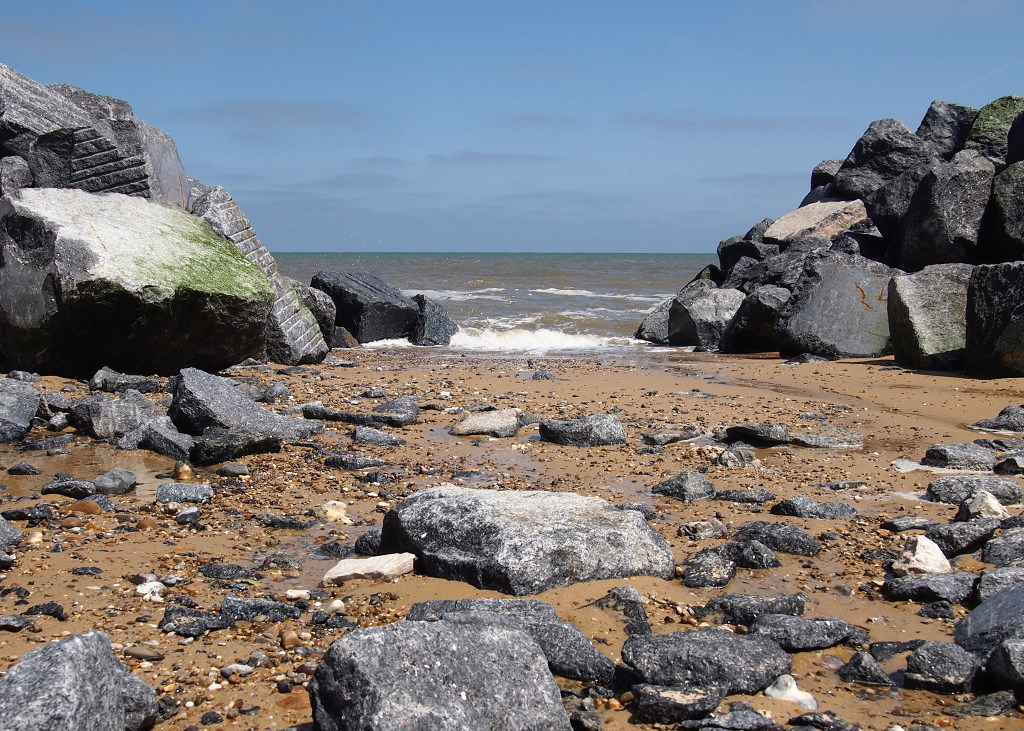
The east coast has to be defended from the sea by placing massive rocks on the beach. Hopton is almost about as far east as you can get. The rocks make little inlets which make for an interesting soundscape, with the rattle of the pebbles against the long swoosh of the incoming waves, with some very low-frequency rumble from the rocks.
The sounds of summer at Bawdsey in the school holidays – a motorboat starts up and moves off, and then the passenger ferry arrives from Felixstowe Ferry
Bawdsey looking towards Felixstowe FerryBawdsey Beach
A couple of jetskis in the distance and lots of people enjoying the summer sun. Recorded for the short-lived British Library Sounds of our Shores project.
The Internet has done for many older forms of exchanging information – physical newspapers and magazine curculations are a shadow of their former selves. Much of this is Schumpeter’s Gale at work. it simply makes it easier to share information and ideas by disntermediating. The publishers and gatekeepers of the old world are rendered redundant. This isn’t an unalloyed win – they performed a role in screening out the rubbish, and this role has now moved to the search engines to try and make sense of the multimedia firehose pointed at your face.
the logo of the former British Sound Recording Association
People moaned that printed publications tended to favour articles that promoted their advertisers’ products. I’m not quite sure that Google adsense is necessarily a step up from that, but being able to share audio, video, images and writing all in the space of a generation is great.
The Long, Slow Vanish Of Britain’s Illustrious Recording Clubs
When the Society was formed, back in 1968, there were many tape recording societies around the country, today there are very a few. A google search only found one other. WSRS has stood the test of time because of the society’s specialist interest.[wildlife sounds]
Paul Pratley, WSRS secretary 2014
and Google was indeed my friend, it’s possible that Paul was already behind the times. The British Sound Recording Association closed its doors in a meeting in Oxford, to be ratified in November 2014.
NPR has a short radio piece with a few snippets culled from the BSRA’s last meeting in Oxford in June 2014. On the face of it it this seems bizarre – in a world full of podcasters and with sound being used more and more for non-music uses it puzzles me how and where the BSRA failed to move forward. I was never a member because I didn’t see what I could learn from it, and I am not a competition guy – I have never been, either in the fields of sound recording or photography, despite the fact than I manage to take pictures and field recordings that people license. I don’t decry competitions or competing – I simply don’t understand.
The problem was called out over forty years ago – if sound is about all about music for you, buy a a good stereo system, not a tape recorder
Dropout called out the problem, in his valedictory column in the last issue of Tape Recorder magazine
[ref]Tape Recorder, April 1970 page 173; you can find back issues in PDF at http://www.americanradiohistory.com/ – look for Studio Sound in Audio and Recording[/ref]
issue before it became Studio Sound.
RECORDING BEGINS WITH A MICROPHONE
Recording begins, oddly enough, with a microphone ; and what your amateur recordist lacks is access to signals which are worth recording, if his interest be confined to music.
Oh, something can be done along those lines ; but how many tapes have you made which
you can replay with the kind of musical satisfaction you get from your chosen repertory
of discs? I’ll bet it’s very few ; I know it is with me.
But then, I long ago abandoned that fantasy, and began to derive my reproduced music from the radio and the gramophone. I use my recorders—three mains’ machines and a battery-portable—for other things; and when I say use, I mean use.
But, with reluctance, I have come to the conclusion that most amateur recordists have no interests with which tape can help them or—which is more likely—they have not the imagination to see what those interests might be.
Dropout, Tape Recorder magazine, April 1970
I was a child when he wrote that and never read it, but there was something magical about going out with a EL3302 cassette recorder and bringing some of the birds back in with me from the garden. The sparrows have now left my parents’ garden in London, indeed for reasons unknown they have left the city en masse.
Sparrow calls in Ipswich
It would have been nice to have had some of those old C60s with London sparrow sounds from the 1970s. Not particularly because they would have sounded that different, probably, but as a memento of flocks long gone.
The Internet has fostered a new breed of sound hunters – and phonography, sound art and field recordists are well represented. It’s not clear to me how the BSRA lost its mojo, but I admire them for having the honesty to recognise it. I do wonder if the contest mindset is perhaps an anachronism in today’s environment – the whole open-source and mashup culture of, say, freesound is a world apart from the highly structured approach of the British Amateur Recording Contest. I wouldn’t know where to start with the latter.
 The Peter Pan-themed lake and the House in the Clouds are the creation of Scottish barrister Glencairn Stuart Ogilvie at the start of the 1900s