For thirty years an electronics and software engineer. Now of independent means. This is my adventure into sound hunting and field recording.
Like Des Coulam of Soundlandscapes, the first time I came across audio recording as a child was with a hand-me-down reel-to-reel tape recorder. It seemed magical to me, but also tantalisingly impractical. This was in the 1970s. It seems there had been an active community of ‘sound hunters’ – what we would now think of as field recordists.
The world was quieter then – far fewer aircraft in the skies, less traffic. All good for what R Murray Schafer called ‘high fidelity soundscapes’1 – ones where the primary sound source isn’t buried in extraneous unrelated background sound. However, these sound hunters were severely limited by the equipment available at the time.
Nowadays I can go to Amazon and pick up a small battery SD card audio recorder for about £80 new.

Small, silent in operation, no moving parts.
Portable tape recorders were to be had. Uher made some for reporters and there was the lovely precision instruments made by Nagra, but the price tag was astronomical. No number of Saturday jobs could get me a Nagra

Cassette recorders made portable recorders cheaper and more practical. It seems all the amateur field recordists had pretty much given up by the time these arrived. These portable recorders were often used for recording music off records. As a young teenager I toted an EL3302 around various places. This was a good machine for impecunious field recordists because they hadn’t moved to the dreadful automatic level controls that marred later recorders in an attempt to make them easier to use.
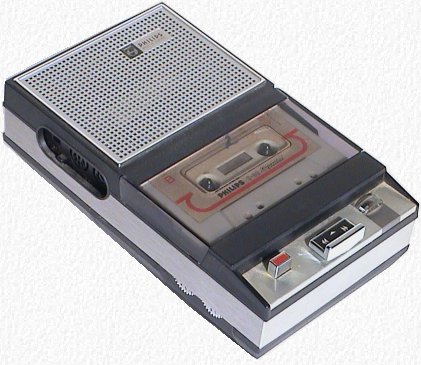
The tapes were still expensive. I wish I still had some of the field recordings I made as a child from London. The cost of tape and records meant that as a teenager I recorded over these field recordings with some now eminently forgettable pop music. Without transport I wasn’t that adventurous a recordist. Some of the recordings were from my parents’ back garden when sparrows and song thrushes still sang in south-east London. The recordings from Oxleas wood would have been nice to keep and perhaps compare over 40 years. These vignettes of 1970s London would be good to contribute to the fabulous London Sound Survey site.
Sound recording hardware has become much cheaper, better and easier to use now. But the world has become much more polluted with man-made noise, particularly aircraft and traffic noise. Other sounds have often become more homogenous, too. Take something as simple as ambulance sirens and telephone bells. These used to be individual mechanical noisemakers, and no two sounded the same because of mechanical tolerances. Now they are more effective, cheaper, but less idiosyncratic in sound.
The simple pleasure of Spring birds in my back garden
The natural world is a great source of interesting sounds. There is still the wonder of birdsong to be found, along with the inspiring sound of natural phenomena life the sound of the sea. People and cities weave a rich tapestry of sounds, and it’s easier than ever to record these.
Taxonomy
I’ll follow Des Coulam of Soundlandscapes in his classification of urban field recordings into
- Atmospheres – overall ambiances
- Locations – sounds associated with a specific place
- Targets – sounds associated with individual sources or small groups
though I record nature sounds as well as sources including urban/human sounds. Those three cover many instances.
Here’s a look at how tough it was not so long ago:
What do I do with my Tape recorder?
The title of Karin Bijsterveld‘s 2004 paper 2 sums up the problems of the early field recordists, and the manufacturers selling them mechanically noisy, mains-tethered machines.

Reading back-issues of Tape Recorder from the excellent AmericanRadioHistory collection, it’s clear that the tape recorder was marketed to the public as a “sound camera” rather than a way to record/play music. It puzzled the manufacturers that this didn’t take off. I’m not sure why – the problem is clear in this photo of a field recording session at London’s Embankment in the Feb 1968 issue.

It’s no fun going out into the wet as it is, but with that massive gear you’re limited to being near a road, and unless they had an inverter presumably they had to prevail upon some kind soul to let them plug the machine in 🙂
Tape Recorder magazine was originally aimed at the amateur owner of a domestic tape recorder. It changed direction to address a more professional readership when it changed to Studio Sound in 1970, but until then you could see some of the other problems faced by wannabe sound hunters – the machines were terribly unreliable, needing frequent repair and wow and flutter were never far away, which played hell with recordings of music.
Not only did phonographers have heavy machines attached to the mains power supply, but these machines were mechanically noisy. To make the electronics cheaper manufacturers provided high-impedance crystal microphones, so the microphone cable was limited to a couple of metres before the cable capacitance slugged the high-frequency performance; our field recordist was therefore limited to a couple of meters away from a noisy tape recorder that was tethered to the mains. Exactly how the manufacturers expected their users to be that creative with these limitations puzzles me, it’s as if a camera came with a fixed wide-angle lens and a mains plug. That might be useful in a professional studio but is kind of limiting in the hands of amateur photographers.
In his valedictory Last Column in the April 1970 issue of Tape Recorder, Dropout summed up the issues
Recording begins, oddly enough, with a microphone ; and what your amateur recordist lacks is access to signals which are worth recording, if his interest be confined to music.
and soon after, for 20 years, recording devices didn’t come with a microphone, or even a microphone input, because people connected then to their record players and the radio to record music. It was only in the 1990s with minidisc and portable DAT that sound recording devices targeted at consumers had mic inputs.
And now the wheel has come full circle, as many SD card devices have on-board stereo microphones, which as often half decent and people actually use them – they record lectures, take notes in the field, and yes, record the sounds around them. The progress of technology has brought us silent recorders untethered to the mains that can go where the sounds are…
- R. Murray Schafer – Tuning of the World 1993 “The hi-fi soundscape is one in which discrete sounds can be heard clearly because of the low ambient noise level … In the hi-fi soundscape, sounds overlap less frequently; there is perspective – foreground and background … In a low-fi soundscape individual acoustic signals are obscured in an overdense population of sounds … Perspective is lost … there is no distance; only presence.” ↩
- sadly behind some paywall – I read it a couple of years ago but the Gollum-esque pay model of academic publishing has sucked it back from open access. ↩